





- October 17, 2024
- FOXITBLOG
As a leading PDF manufacturer, Foxit is actively working on the realization of new PDF 2.0 possibilities. In many cases, multiple stakeholders are needed to make these advanced functions available to users as a consistent end-to-end solution.
Accessible math—the practices, resources, and technologies designed to make mathematics comprehensible and usable for individuals with disabilities, including those who are blind, visually impaired, or have learning disabilities—is one such crucial area where Foxit initiated, actively supported, and delivered the first proof-of-concept (PoC) implementation.
The Limitations of Legacy Standards: PDF 1.7 and PDF/UA-1
Accessibility for mathematical formulas was difficult to achieve in PDF 1.7 and PDF/UA-1. As a workaround, documents often used a static image of a formula accompanied by a brief alt-text description.
While this approach worked for simple equations—such as the Pythagorean theorem ($a^2 + b^2 = c^2$) or Einstein’s $E=mc^2$—it completely fell short for complex mathematical expressions, where interactive navigation within the formula itself is essential for screen reader users.
The Breakthrough: MathML, PDF 2.0, and PDF/UA-2
The introduction of PDF 2.0 and PDF/UA-2 opened up significantly better capabilities for math through MathML (Mathematical Markup Language)—an XML-based markup language specifically designed for mathematical expressions and formulas.
PDF 2.0 supports structured object names via namespaces and introduces the Formula Tag, which points to an embedded associated file containing the formula markup. On this basis, mathematical content can finally be made fully accessible.
Solving the End-to-End “Chicken-and-Egg” Challenge
In practice, enabling accessible math posed a classic “chicken-and-egg” problem: creating a seamless end-to-end user experience required multiple applications across the publishing toolchain to adopt these new standards simultaneously.
-
Authoring & Conversion: LaTeX is widely used by universities, scientific publishers, and academic journals to author complex technical documents. Once compiled, these documents are converted to PDF.
-
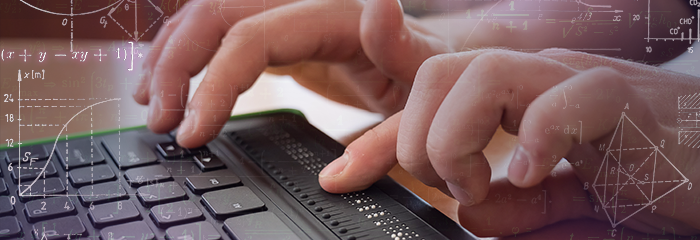
Reading & Assistive Technology: Visually impaired readers rely on screen readers like NVDA or JAWS alongside a PDF viewer (such as Foxit PDF Reader) to read or edit the text via screen audio or Braille displays.
To bridge this gap, Foxit collaborated across the ecosystem—ensuring that MathML content in PDFs can be properly exposed to assistive tools. Currently, Foxit is the only solution on the market capable of exposing math contained in PDFs to screen readers.
Foxit’s Pioneer Role in the PDF Association Proof of Concept
Foxit initiated a proof of concept within the PDF/UA Technical Working Group (TWG) of the PDF Association to realize the first practical implementation:
-
Viewer & Editor Support: Display and editing capabilities for MathML were built into Foxit PDF Editor and Foxit PDF Reader.
-
Screen Reader Integration: Foxit expanded its PDDom interface (API) and worked closely with an NVDA expert to create a specialized NVDA plugin for reading MathML.
-
LaTeX Workflow Enhancements: Working within the PDF Association’s LaTeX Working Group, Foxit helped optimize how LaTeX formulas are converted into PDF/UA-2 compliant PDFs.
The results of this PoC will gradually be incorporated into future application releases, helping make all PDFs generated from LaTeX inherently accessible and PDF/UA-2 compliant.
Building an Inclusive Ecosystem Together
For over 20 years, the global community has strived to make mathematics accessible in digital documents. At Foxit, we are proud to be at the forefront of breaking down these barriers.
We hope our progress inspires other industry leaders—including Apple, Microsoft, Adobe, and assistive technology developers—to take the next steps. By enhancing screen readers (like VoiceOver), refining PDF export engines, and advancing PDF viewers together, we can build a truly inclusive ecosystem where everyone can engage with mathematical content seamlessly and meaningfully.